Enclosure ventilation

Bmwhit

New Member
Joined
Aug 28, 2024
Messages
3
Location (City and/or State)
Texas
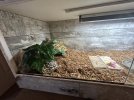
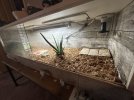
I have an enclosure I have made (not the prettiest) and I was wondering if I should add ventilation. I have a thermostat hygrostat with CHE and reptile fogger plugged into it. When the CHE is off my humidity climbs and hygrometer flashes HH (humidity high). I am getting conflicting info on if too high humidity can be harmful.

I included a few pictures. If there is anything blatantly wrong please let me know, I will be making adjustments this weekend.IMG_3527.jpegIMG_3526.jpegIMG_3525.jpeg
 

wellington

Well-Known Member
Moderator
10 Year Member!
Tortoise Club
Platinum Tortoise Club
Joined
Sep 6, 2011
Messages
53,937
Location (City and/or State)
Chicago, Illinois, USA
First, remove the fogger it can make them sick.
Second, wet the substrate to keep humidity up.
Third, a leopard needs 80% humidity but higher will not hurt them as long as temps are never below 80 and basking 95-100.
You don't need ventilation. There is enough air exchange when you open the enclosure to feed, water, clean and take them out for soaks. Plus, the enclosure is not air tight
Also be very cautious of any info outside this forum, it's usually wrong outdated info.
 

wellington

Well-Known Member
Moderator
10 Year Member!
Tortoise Club
Platinum Tortoise Club
Joined
Sep 6, 2011
Messages
53,937
Location (City and/or State)
Chicago, Illinois, USA
How big is your leopard? Once they reach 10 inches straight measurement bottom shell they should be living outside in a much bigger enclosure and don't need a closed chamber. The humidity then should be in a humid hide that's heated when needed
If you don't have outdoor space then he needs a room size enclosure
 

Bmwhit

New Member
Joined
Aug 28, 2024
Messages
3
Location (City and/or State)
Texas
How big is your leopard? Once they reach 10 inches straight measurement bottom shell they should be living outside in a much bigger enclosure and don't need a closed chamber. The humidity then should be in a humid hide that's heated when needed
If you don't have outdoor space then he needs a room size enclosure
He’s a yearling, I have a large outdoor area being worked on. We have 1.5 acres in southeast Texas, he’s just too small for me to be comfortable leaving him unsupervised outdoors
 

wellington

Well-Known Member
Moderator
10 Year Member!
Tortoise Club
Platinum Tortoise Club
Joined
Sep 6, 2011
Messages
53,937
Location (City and/or State)
Chicago, Illinois, USA
Yes, he needs to be 10 inches before living outside.
At a year old, he does need to still be in the closed chamber.
 

Tom

The Dog Trainer
10 Year Member!
Platinum Tortoise Club
Joined
Jan 9, 2010
Messages
68,417
Location (City and/or State)
Southern California
He’s a yearling, I have a large outdoor area being worked on. We have 1.5 acres in southeast Texas, he’s just too small for me to be comfortable leaving him unsupervised outdoors
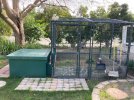
Here is one safe way to do the outdoors once he's large enough:
IMG_1050.jpg

This is a 8x8 chicken coop from Tractor Supply. I put a visual barrier around the bottom, and attached a 4x4 insulated and heated box to it.

Your enclosure looks super cool, but I don't see a basking lamp. The CHE set on a thermostat is a great way to maintain ambient heat, but it needs to be in the middle of the enclosure for that. There should be an incandescent flood bulb for basking over in that socket on the side.

I agree that foggers should not be used in tortoise enclosures, and you shouldn't need it with a large closed chamber like yours. Most enclosures do have some vents on them, so that wouldn't be a bad idea, but it really depends on the conditions.

Much more info here:
 

Bmwhit

New Member
Joined
Aug 28, 2024
Messages
3
Location (City and/or State)
Texas
Here is one safe way to do the outdoors once he's large enough:
View attachment 378289

This is a 8x8 chicken coop from Tractor Supply. I put a visual barrier around the bottom, and attached a 4x4 insulated and heated box to it.

Your enclosure looks super cool, but I don't see a basking lamp. The CHE set on a thermostat is a great way to maintain ambient heat, but it needs to be in the middle of the enclosure for that. There should be an incandescent flood bulb for basking over in that socket on the side.

I agree that foggers should not be used in tortoise enclosures, and you shouldn't need it with a large closed chamber like yours. Most enclosures do have some vents on them, so that wouldn't be a bad idea, but it really depends on the conditions.

Much more info here:
Thanks for the reply, I have an Arcadian T5 uvb and some LEDs do I need something in addition to that?
 

The_Four_Toed_Edward

Well-Known Member
Joined
Apr 6, 2024
Messages
6,236
Location (City and/or State)
Finland
Leopards are a basking species, so an incandesant flood bulb that provides heat should be placed next to the T5 UVB. It is more natural for them to heat up in the sun (heat lamp) and receive UVB at the same time.
 
  • Like
Reactions: Tom

Tom

The Dog Trainer
10 Year Member!
Platinum Tortoise Club
Joined
Jan 9, 2010
Messages
68,417
Location (City and/or State)
Southern California
Thanks for the reply, I have an Arcadian T5 uvb and some LEDs do I need something in addition to that?
Yes. You need a basking bulb.

Here is a breakdown of the four heating and lighting essentials:
  1. Basking bulb. I use 65 watt incandescent floods from the hardware store. Some people will need bigger, or smaller wattage bulbs. Let your thermometer be your guide. I run them on a timer for about 12 hours and adjust the height to get the correct basking temp under them. I also like to use a flat rock of some sort directly under the bulb. You need to check the temp with a thermometer directly under the bulb and get it to around 95-100F (36-37C).
  2. Ambient heat maintenance. I use ceramic heating elements or radiant heat panels set on thermostats to maintain ambient above 80 degrees day and night for tropical species. In most cases you'd only need day heat for a temperate species like Testudo or DT, as long as your house stays above 60F (15-16C) at night. Some people in colder climates or with larger enclosures will need multiple CHEs or RHPs to spread out enough heat.
  3. Ambient light. I use LEDs for this purpose. Something in the 5000-6500K color range will look the best. Most bulbs at the store are in the 2500K range and they look yellowish. Strip or screw-in LED bulb types are both fine.
  4. UV. If you can get your tortoise outside for an hour 2 or 3 times a week, you won't need indoor UV. In colder climates, get one of the newer HO type fluorescent tubes. Which type will depend on mounting height. 5.0 bulbs make almost no UV. I like the 12% HO bulbs from Arcadia. You need a meter to check this: https://www.solarmeter.com/model65.htmlA good UV bulb only needs to run for 2-3 hours mid day. You need the basking bulb and the ambient lighting to be on at least 12 hours a day.
 

New Posts

Top