Donoghue Ratio

Clawrrr

New Member
Joined
Jun 13, 2024
Messages
3
Location (City and/or State)
FLORIDA
Hello all!

Curious to see what the majority of members think about the Donoghue Ratio when it comes to determining healthy tortoise weights.

I saw a previous post on here about this subject, but it was from many years ago and is closed for comments. Was just wondering if anyone’s found anything new about the formula’s accuracy regarding various types of torts.

We find that it’s pretty accurate for our Western Hermanns and Redfoots— we see physical signs that tell us they’re overweight or underweight and the Donoghue Ratio confirms it. But we recently acquired elongateds and were wondering if they were included in the original study and if this ratio applies to them.

Thoughts/observations/opinions much appreciated.

I’ve included a picture of our Western Hermanns, Opal. She’s a thiccums 🤣😂🤣
IMG_5039.jpeg
 

The_Four_Toed_Edward

Well-Known Member
Joined
Apr 6, 2024
Messages
6,256
Location (City and/or State)
Finland
I don't have an opinion on this, just an experience to share. I always weigh my adult male Russian tortoise after a soak. His weight is usually about 500 g.

According to the donoghue ratio, my tortoise is overweight 500/(12^3x0.191)=1.51493116153
But in my opinion he doesn't look overweight.I used this thread as a guide https://tortoiseforum.org/threads/tortoise-weight-formula-tbmi.38420/

I have believed him to be of a healthy weight. When I first joined @SinLA commented that his Russian male was about the same size. And after googling about the ratio I decided that maybe my tortoise is a healthy weight after all. Also, I think @Yvonne G has said that overweight tortoises are uncommon (if I remember correctly).

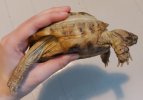
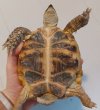
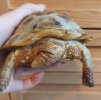
Here are photos of him when I first got him. He was also about 500 grams back then (yes he has a overgrown beak in these photos).
 

Attachments

  • 20240409_120743.jpg
    20240409_120743.jpg
    554.2 KB · Views: 2
  • 20240409_120757.jpg
    20240409_120757.jpg
    732.8 KB · Views: 2
  • 20240409_120735.jpg
    20240409_120735.jpg
    839.9 KB · Views: 2
  • 20240428_142059.jpg
    20240428_142059.jpg
    738.7 KB · Views: 2

Clawrrr

New Member
Joined
Jun 13, 2024
Messages
3
Location (City and/or State)
FLORIDA
Hello all!

Curious to see what the majority of members think about the Donoghue Ratio when it comes to determining healthy tortoise weights.

I saw a previous post on here about this subject, but it was from many years ago and is closed for comments. Was just wondering if anyone’s found anything new about the formula’s accuracy regarding various types of torts.

We find that it’s pretty accurate for our Western Hermanns and Redfoots— we see physical signs that tell us they’re overweight or underweight and the Donoghue Ratio confirms it. But we recently acquired elongateds and were wondering if they were included in the original study and if this ratio applies to them.

Thoughts/observations/opinions much appreciated.

I’ve included a picture of our Western Hermanns, Opal. She’s a thiccums 🤣😂

Hubby just informed me that Opal is an Eastern Hermanns. I feel so silly. Still very new to tortoise husbandry. 😅 BUT I love them already, find them super fascinating, and am eager to learn how to be a good tort momma.
 

Clawrrr

New Member
Joined
Jun 13, 2024
Messages
3
Location (City and/or State)
FLORIDA
I don't have an opinion on this, just an experience to share. I always weigh my adult male Russian tortoise after a soak. His weight is usually about 500 g.

According to the donoghue ratio, my tortoise is overweight 500/(12^3x0.191)=1.51493116153
But in my opinion he doesn't look overweight.I used this thread as a guide https://tortoiseforum.org/threads/tortoise-weight-formula-tbmi.38420/

I have believed him to be of a healthy weight. When I first joined @SinLA commented that his Russian male was about the same size. And after googling about the ratio I decided that maybe my tortoise is a healthy weight after all. Also, I think @Yvonne G has said that overweight tortoises are uncommon (if I remember correctly).

Here are photos of him when I first got him. He was also about 500 grams back then (yes he has an overgrown beak in these photos).
Thank you for your response! That’s a super interesting point you make. Makes me wonder if Russian tortoises were included when Donoghue was collecting data for the ratio. I wonder if the ratio yielded inaccurate results because the Russians are usually rounder/flatter than say a Sulcata or redfoot. Sweet Russian! Yea, they don’t look overweight to me.
 

Alex and the Redfoot

Well-Known Member
Platinum Tortoise Club
Joined
Aug 21, 2023
Messages
5,298
Location (City and/or State)
Cyprus
Thank you for your response! That’s a super interesting point you make. Makes me wonder if Russian tortoises were included when Donoghue was collecting data for the ratio. I wonder if the ratio yielded inaccurate results because the Russians are usually rounder/flatter than say a Sulcata or redfoot. Sweet Russian! Yea, they don’t look overweight to me.
Hello!
I can't find the original paper, so don't know what exact species were studied. However, one of the main concerns was that formula is not species-specific (just like Jackson's ratio). The magic number 0.191 encodes "an average normal density tortoise with standard carapace volume", so the formula should be used with caution (pancakes, adult redfoots and box turtles are very different).

When applying formula it should be kept in mind that there is a probability that tortoise is fine even when it doesn't hit the target weight (let's assume 30% chance of being normal with 75% of target weight).

There are more papers on exact species (I've seen Hermanni, Greeks and Redfooteds) where some adjustments to the formula were made. However, I would just skip the idea of "target weight" and set a baseline for your individual tortoises and look at the dynamics.
 

The_Four_Toed_Edward

Well-Known Member
Joined
Apr 6, 2024
Messages
6,256
Location (City and/or State)
Finland
Thank you for your response! That’s a super interesting point you make. Makes me wonder if Russian tortoises were included when Donoghue was collecting data for the ratio. I wonder if the ratio yielded inaccurate results because the Russians are usually rounder/flatter than say a Sulcata or redfoot. Sweet Russian! Yea, they don’t look overweight to me.
Yeah, I will try to find whether Russians were included and if there should be some adjustments to make. Also, some Russians are rounder than others (some people believe there are sub-species, or local variance). Overall, mine seems to be of a healthy weight, no matter the donoghue ratio.
 

Tom

The Dog Trainer
10 Year Member!
Platinum Tortoise Club
Joined
Jan 9, 2010
Messages
68,429
Location (City and/or State)
Southern California
Hello all!

Curious to see what the majority of members think about the Donoghue Ratio when it comes to determining healthy tortoise weights.

I saw a previous post on here about this subject, but it was from many years ago and is closed for comments. Was just wondering if anyone’s found anything new about the formula’s accuracy regarding various types of torts.

We find that it’s pretty accurate for our Western Hermanns and Redfoots— we see physical signs that tell us they’re overweight or underweight and the Donoghue Ratio confirms it. But we recently acquired elongateds and were wondering if they were included in the original study and if this ratio applies to them.

Thoughts/observations/opinions much appreciated.

I’ve included a picture of our Western Hermanns, Opal. She’s a thiccums 🤣😂🤣
View attachment 374547
Tortoises come in all sorts of different sizes and shapes, and therefore volume. Even males and females of the same species can be shaped entirely differently, as in the case of red foot or Burmese star tortoises.

Because of this fact, these ratios are meaningless. Your tortoise should feel heavy and dense for its size. It should not feel hollow, or light weight for its size.

Ideally, babies should be weighed weekly and juveniles or adults weighed monthly, following the same routine, such as before or after a soak, and at the same time of day each time, either before or after eating. If I weigh before a soak, which emits them out, and after a meal of opuntia pads, which are very heavy with water compared to lighter weight foods, the weight difference can be astonishing. That same tortoise after a long soak and before eating the next day, could be significantly lighter, even though it is very healthy.

For babies and juveniles, we are looking for steady growth. Rate of growth is unimportant, as long as there is continuous growth month to month. If there isn't, we know we have a problem somewhere.

For adults that are fully grown, I would expect some variation from day to day and seasonally too, but it should remain fairly consistent.
 

New Posts

Top