Questions

Status
Not open for further replies.

BrinnANDTorts

Member
10 Year Member!
Joined
Oct 18, 2011
Messages
958
Why do sulcata diets need a lot of variety if in the wild all they do is graze on grass for food?
All I feed Gupta and my greeks now is grass, clovers, and weeds that I just rip up from outside and a whole bunch of cactus pad for calcium. That's all I plan to feed them , not gonna buy any foods except for the cactus pads and i'm not messing with supplements any more. I'll change if something seems wrong but I don't think it will be. Its just the same as if they could live outside year around , they would just eat grass and cactus pad for calcium and have the sun.
SIDE NOTE:
I also don't see why people say that fluorescent UVB lights are worthless :( Everyone had their own opinions and thats cool I respect that totally but they work for my tortoises better than anything. Gupta has a rock hard shell, hardest its ever been since I put him under a full spectrum UVB light , its bright, bright, bright white light. I also have a 10.0 flourescent UVB light
He keeps a seriously , seriously dark dark tan.
They are cheaper in price, use less electricity, don't have to be mounted a foot away from the substrate just so they don't scorch your tortoise, and are better for humidity. admittedly after months and months of using them I might end up hating them but right now they seriously rock and I've been using them for awhile
I read a lot of people just telling others that they just suck, but they can be really really useful.
 

dmarcus

Active Member
5 Year Member
Joined
Mar 25, 2011
Messages
9,036
Location (City and/or State)
Las Vegas, NV
Not everyone has grass available for there tortoise to eat so they have to buy the grocery store greens and dry foods like mazuri.
Right now all my grass and weeds are either dead or have gone dormant and my sulcata's have nothing to graze on right now so I have to finds other ways to feed them. So since I have to buy the greens I just make sure it's a varity to ensure they are getting all the good things they need.

Remember that everyone is just giving suggestions and it's up to the individual owner to decided what works best for them and there tortoise.
 

wildponey21

New Member
5 Year Member
Joined
Dec 6, 2010
Messages
184
well i have the mvp blub no my sullys but my red foots have a 10.0 flouresent and they are ging very good. i feed all differnt green from my store and dry foods also hays. I live by a wegamns wich keeps catus pads in stock for me
 

Tom

The Dog Trainer
10 Year Member!
Platinum Tortoise Club
Joined
Jan 9, 2010
Messages
68,419
Location (City and/or State)
Southern California
I'll take 'em one at a time.
1. The danger without supplements is nutrient and trace element deficiencies. Even if one were to do a nutritional breakdown of those species of plants that you are feeding, there can be a very large degree of variability based on the soil that the plant is grown in. For example: Plants grown in calcium poor soil will generally have less calcium than the same plants grown in calcium rich soil. Three questions for you. Are you sure of the composition of the soil your tortoise food is growing in? Are you sure that you will be providing enough calcium for an animal that can go from 35 grams to 45,359 grams in the space of ten years? They need a lot. Are you sure you are providing enough UV for them to use the available calcium? See number 2.

2. I frequently say that florescents do not put out enough UV to prevent MBD. This has been my observation with many reptiles over many years in many situations. I have repeatedly rehabbed beardies and green iguanas that were under florescent UV light and still got MBD. The bulbs were regularly replaced most of the time and placed at the distances recommended. To be fair there were also times where the bulbs were too far or not replaced often enough, but I still would not recommend that any one rely on them as their sole source of UV. If your tort gets sun regularly then I think florescents are fine and a good way to light up the enclosure. I have never encountered a case of MBD in an animal housed under a MVB or one that gets regular sunshine. All torts need to be able to warm up enough to properly function. There is much debate about just how warm that needs to be, but no bulb of any kind should be set close enough to "scorch" anything. All of my bulbs whether they are regular incandescents or MVB are set at the right height to create the basking temp of my choice. To be clear, I don't think florescent bulbs "suck", but I would never rely on them as my sole source of UV for an indoor animal.


As a side note, make sure your clover is clover and not oxalis. I made this mistake for quite a while before I learned the difference. In a situation with out supplements or adequate UV this problem could be compounded.
 

CtTortoiseMom

New Member
5 Year Member
Joined
Jan 17, 2011
Messages
4,515
Location (City and/or State)
CT
My tort's just eat grasses and weeds when weather permits. When they are inside for the winter I give them a varied diet with supplements to make sure they have as balanced of a diet as possible until they can get outside again. It sounds like you live in a much warmer area than me because I have not had grass and clovers for months.
 

EKLC

Member
5 Year Member
Joined
Nov 10, 2010
Messages
605
The diet of a wild tortoise is extremely varied. One study observed tortoises consuming dozens of species of grasses, succulents, broadleaf weeds, flowering plants, plus tidbits like hyena poop and fruits. It's hard to reproduce the nutritional subtleties of a diverse wild diet, especially considering the differences in nutrient profile based on soil conditions.
 

Jacqui

Wanna be raiser of Lemon Drop tortoises
Moderator
10 Year Member!
Joined
Aug 28, 2007
Messages
39,929
Location (City and/or State)
A Land Far Away...
I am sorta at a lost as to why your saying your not going to feed a variety of food, when you are. Variety does not mean it has to be store bought. Variety is also in those different weeds, grasses and clover your feeding.

EKLC said:
The diet of a wild tortoise is extremely varied. One study observed tortoises consuming dozens of species of grasses, succulents, broadleaf weeds, flowering plants, plus tidbits like hyena poop and fruits. It's hard to reproduce the nutritional subtleties of a diverse wild diet, especially considering the differences in nutrient profile based on soil conditions.

I want to say this is a great point you have made!
 

BrinnANDTorts

Member
10 Year Member!
Joined
Oct 18, 2011
Messages
958
CtTortoiseMom said:
My tort's just eat grasses and weeds when weather permits. When they are inside for the winter I give them a varied diet with supplements to make sure they have as balanced of a diet as possible until they can get outside again. It sounds like you live in a much warmer area than me because I have not had grass and clovers for months.

Yea I live in Texas :)

Jacqui said:
I am sorta at a lost as to why your saying your not going to feed a variety of food, when you are. Variety does not mean it has to be store bought. Variety is also in those different weeds, grasses and clover your feeding

Well they are kinda the same basic one or two different grasses and two different kinds of clovers.


Tom said:
I'll take 'em one at a time.
1. The danger without supplements is nutrient and trace element deficiencies. Even if one were to do a nutritional breakdown of those species of plants that you are feeding, there can be a very large degree of variability based on the soil that the plant is grown in. For example: Plants grown in calcium poor soil will generally have less calcium than the same plants grown in calcium rich soil. Three questions for you. Are you sure of the composition of the soil your tortoise food is growing in? Are you sure that you will be providing enough calcium for an animal that can go from 35 grams to 45,359 grams in the space of ten years? They need a lot. Are you sure you are providing enough UV for them to use the available calcium? See number 2.

2. I frequently say that florescents do not put out enough UV to prevent MBD. This has been my observation with many reptiles over many years in many situations. I have repeatedly rehabbed beardies and green iguanas that were under florescent UV light and still got MBD. The bulbs were regularly replaced most of the time and placed at the distances recommended. To be fair there were also times where the bulbs were too far or not replaced often enough, but I still would not recommend that any one rely on them as their sole source of UV. If your tort gets sun regularly then I think florescents are fine and a good way to light up the enclosure. I have never encountered a case of MBD in an animal housed under a MVB or one that gets regular sunshine. All torts need to be able to warm up enough to properly function. There is much debate about just how warm that needs to be, but no bulb of any kind should be set close enough to "scorch" anything. All of my bulbs whether they are regular incandescents or MVB are set at the right height to create the basking temp of my choice. To be clear, I don't think florescent bulbs "suck", but I would never rely on them as my sole source of UV for an indoor animal.


As a side note, make sure your clover is clover and not oxalis. I made this mistake for quite a while before I learned the difference. In a situation with out supplements or adequate UV this problem could be compounded.

I'm completely unsure about the oxalis subject, I will have to google images what an oxali looks like and everything and compare.

I haven't been using the calcium supplement very much lately and its been okay, I just have a really, really hard time getting them to eat the white powder calcium. :( they love cactus pad though, if they see that white powder calcium on something that just don't eat it very much if at all and I tried liquid but it tastes so awful they literally spit the food back out.
I would just use a MVB but the lowest wattage they come in is 100 watt and in my Gupta's enclosure its too short for that powerful of a bulb and its completely covered so I have no way of putting the bulb at the right height. I might be able to come up with a way
Same thing in my Greeks enclosure , so the fluorescents just are easier for me to work with. They have been working really great so far.. I watch my tortioses very closely. If they start to lose color I would notice and correct situtation , does MBD set in that fast ?
Is how dark and tan their skin in not a good indicator of enough UVB?
All my tortoises have a way to heat their bodies up as much as 105 degress under the CHE , and it stays around 85 everywhere.
 

EKLC

Member
5 Year Member
Joined
Nov 10, 2010
Messages
605
My tort hates calcium on the food too. I put a thin layer of calcium on his eating rock, then put the food on top of it. He accidentally consumes the calcium, as though it were messy substrate sticking to the food, but doesn't seem to mind since it's not put on the food.
 

Sammy

New Member
5 Year Member
Joined
Oct 28, 2011
Messages
181
Location (City and/or State)
Hong Kong
My red foot won't eat anythadded to her veggies/fruits. Only Way to supplement her is mix it with Mazuri.
 

Tom

The Dog Trainer
10 Year Member!
Platinum Tortoise Club
Joined
Jan 9, 2010
Messages
68,419
Location (City and/or State)
Southern California
Oh Brinn, you should not feel the need to defend your methods. I hope you don't feel that way. Everybody needs to do things differently to fit their own situation and judging from what I have seen of your tortie, you are doing a great job. Do you chart the growth rate? That is another way to clearly keep track of how well your methods are working. Nice steady growth in a small sulcata is usually a pretty good indicator of health.

About the oxalis: What color and type of flowers does your clover produce? Oxalis makes inch long, yellow, trumpet shaped flowers. No other clover type plant makes that sort of flower.

About the calcium: If you are just using a tiny pinch and mixing it up amongst the greens, it shouldn't be a deterrent. If it is, Gupta may need to learn a little lesson in hunger. Better to nip pickiness in the bud early on, in my opinion. I am spoiled since my hatchlings are getting calcium powder in the brooder box, before they even absorb their yolk sacs entirely.

About the UV: I have not found them to tan indoors under artificial UV. Usually darkening indoors is due to staining from the substrate and it looks different to me than the "tanning" that I see outdoors. This is just completely anecdotal and there are many variables here, so I would not argue at all if someone else had seen something different. I'm just sharing my observations from my babies.

About MBD: How quickly it shows is variable and there are just too many factors to list. In a typical bad case, (NOT yours) it would take weeks or months to show up. And it would usually be a slow process depending on UV, diet, Calcium, the last time the animal saw sunshine, how much sunshine it saw, the season it saw it (stronger UV in summer than winter), where in the world it saw it (stronger UV in Southern TX than in Northern Vermont), etc... Heck even the calcium content of the drinking water can be a factor. It is because of all of these variables that I choose to err on the side of caution. My torts get lots of sun, a great varied diet, good hydration, but I STILL choose to supplement their calcium intake a bit, and I think the Mazuri helps too. In most cases with most tortoises it will take a long time for the results of deficiencies to show up. and it will likewise take a long time to correct those deficiencies. It is nearly impossible to estimate just how much is "good enough" in a given situation. I think with lots of sunshine, good hydration and the right diet it is definitely possible to raise a healthy sulcata with no calcium supplementation. I also think it is fairly difficult to really assess if you have met all the right factors, and so some supplementation is just the prudent course of action.

Anecdotally, Yvonne pointed out her experience with her Aldabras, and I've seen it elsewhere too. It is my opinion that the giant species (which include sulcatas for me) need more calcium supplementation than some other species. They just grow SOOOOO much in a relatively short time. It requires a tremendous amount of calcium to grow those bones to support all that weight and to grow that giant calcified carapace. Many believe that calcium is a big factor in preventing pyramiding too. I've seen anecdotal evidence both ways on this, but I'm erring on the side of "better to get more than you need and excrete out the extra, than to not get enough".

Hope this helps explain my thoughts on some of this.
 

Kristina

Well-Known Member
10 Year Member!
Joined
Dec 18, 2008
Messages
5,383
Location (City and/or State)
Cadillac, Michigan
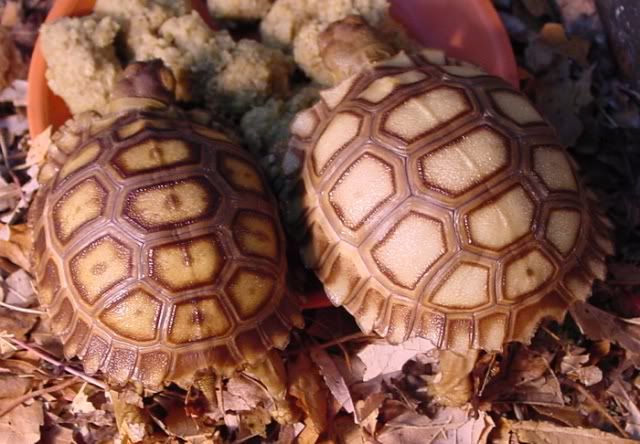
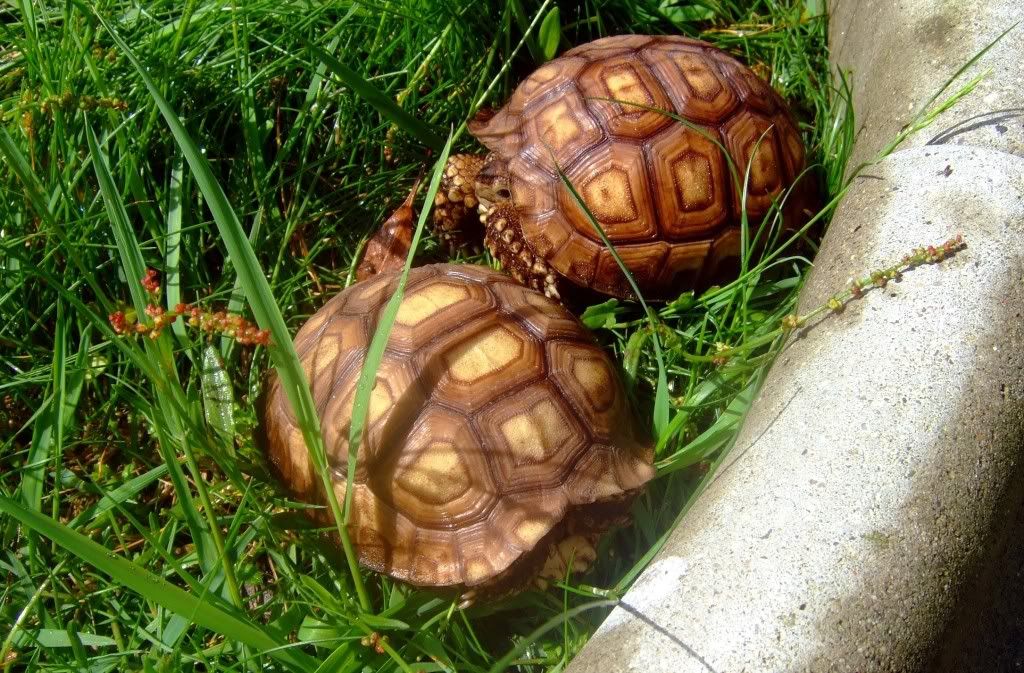
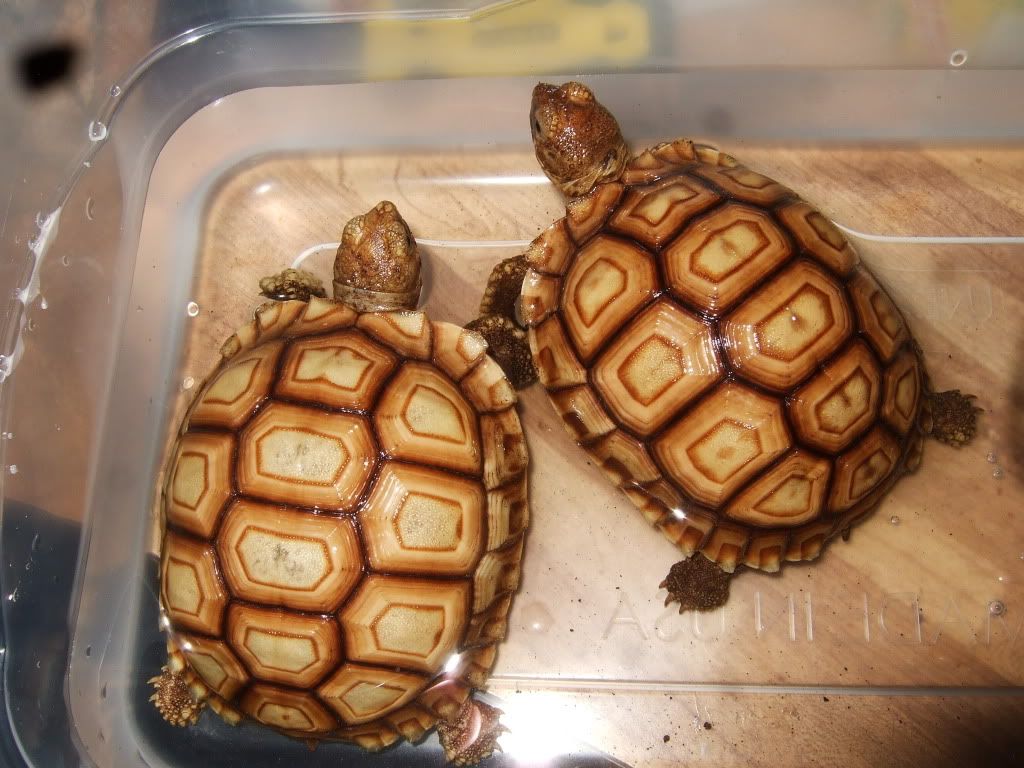
One thing I want to point out about "dark tan" and "losing color..."

A tortoise kept in the sunlight will not have those dark rings. The dark color actually comes from not having enough light. The shell grows out dark in order to absorb heat and UV rays better. Exposure to high UV/sunlight causes those dark areas to LIGHTEN.

Let me show you -

These are my two baby Sullies Kendall and Kasey. This is what they looked like very young.

1102125.jpg


The light scute centers are the color they were born with. The dark growth is new growth.

Now, here is what they looked like at about 5 months old. This was when they went outside for the first time in their lives. Look how dark they are.

KristinasPictures116.jpg


Okay, final picture. After a summer outside and a month back indoors, look at how light they are. The only dark areas are the new growth since being in the house.

220.jpg


What I want you to understand is that just because they are dark colored, that doesn't mean they are getting enough UV.

I am one that often says that UV lights are pretty much worthless - the TUBE florescent UV lights that is, not ALL UV lights. Like Tom mentioned above, I too have over the years rescued and rehabbed more tortoises, iguanas, etc that were kept under these lights and STILL developed MBD. There is absolutely positively no substitute for real sunlight. The closest and best lamp to mimic real sunlight is an MVB.

I personally do not use UV lighting. I never have, and all of my tortoises are hard and healthy. This is partially due to diet and good hydration but also due to the fact that they receive real sunlight for at least 6 months of the year.

I just hate to see someone rely on a tube florescent and then have the worst happen.
 

Tom

The Dog Trainer
10 Year Member!
Platinum Tortoise Club
Joined
Jan 9, 2010
Messages
68,419
Location (City and/or State)
Southern California
Here are two of my hatchlings. The one on the left is around 4 weeks old and has been in the sun for around 10-12 hours spread out over that time. The one on the right is just hatched and is almost ready to come out of the brooder box. It has not yet seen the sun.

kdskk7.jpg

30lhpqr.jpg
 

ShadowRancher

Active Member
10 Year Member!
Joined
Nov 8, 2011
Messages
968
Location (City and/or State)
Columbia, SC
Hey Brinn I'm not experienced enough to answer your questions :p but I just wanted to thank Kristina for sharing her photos they are a great illustration of how sunlight effects the shell, I'm not sure I quite understood exactly what ever one meant before :shy: ...so thank you!


Ahh, Tom too...we posted at the same time :tort:
 

BrinnANDTorts

Member
10 Year Member!
Joined
Oct 18, 2011
Messages
958
Oh Brinn, you should not feel the need to defend your methods. I hope you don't feel that way. Everybody needs to do things differently to fit their own situation and judging from what I have seen of your tortie, you are doing a great job. Do you chart the growth rate? That is another way to clearly keep track of how well your methods are working. Nice steady growth in a small sulcata is usually a pretty good indicator of health.
He is growing , definately. I weigh him and he has gained 20 grams or so, more now since the last time I weighed him. That might slow with him eating nothing but grasses, clovers, and such

About the oxalis: What color and type of flowers does your clover produce? Oxalis makes inch long, yellow, trumpet shaped flowers. No other clover type plant makes that sort of flower.
O the clovers I am feeding him don't have any flowers on them
they are three leafed and I am not sure what the other is


About the calcium: If you are just using a tiny pinch and mixing it up amongst the greens, it shouldn't be a deterrent. If it is, Gupta may need to learn a little lesson in hunger. Better to nip pickiness in the bud early on, in my opinion. I am spoiled since my hatchlings are getting calcium powder in the brooder box, before they even absorb their yolk sacs entirely.
It's so odd because I have just discovered that my Greeks love calcium...I spilled a little on their substrate and they were trying to eat the straight calcium..I was like wow..They also love that Zoo Med grassland stuff but Gupta doesn't like calcium or the Grassland food. He just picks at it
I'm gonna try and do the little hunger thing to get him to get over it


About the UV: I have not found them to tan indoors under artificial UV. Usually darkening indoors is due to staining from the substrate and it looks different to me than the "tanning" that I see outdoors. This is just completely anecdotal and there are many variables here, so I would not argue at all if someone else had seen something different. I'm just sharing my observations from my babies.

About MBD: How quickly it shows is variable and there are just too many factors to list. In a typical bad case, (NOT yours) it would take weeks or months to show up. And it would usually be a slow process depending on UV, diet, Calcium, the last time the animal saw sunshine, how much sunshine it saw, the season it saw it (stronger UV in summer than winter), where in the world it saw it (stronger UV in Southern TX than in Northern Vermont), etc... Heck even the calcium content of the drinking water can be a factor. It is because of all of these variables that I choose to err on the side of caution. My torts get lots of sun, a great varied diet, good hydration, but I STILL choose to supplement their calcium intake a bit, and I think the Mazuri helps too. In most cases with most tortoises it will take a long time for the results of deficiencies to show up. and it will likewise take a long time to correct those deficiencies. It is nearly impossible to estimate just how much is "good enough" in a given situation. I think with lots of sunshine, good hydration and the right diet it is definitely possible to raise a healthy sulcata with no calcium supplementation. I also think it is fairly difficult to really assess if you have met all the right factors, and so some supplementation is just the prudent course of action.

Anecdotally, Yvonne pointed out her experience with her Aldabras, and I've seen it elsewhere too. It is my opinion that the giant species (which include sulcatas for me) need more calcium supplementation than some other species. They just grow SOOOOO much in a relatively short time. It requires a tremendous amount of calcium to grow those bones to support all that weight and to grow that giant calcified carapace. Many believe that calcium is a big factor in preventing pyramiding too. I've seen anecdotal evidence both ways on this, but I'm erring on the side of "better to get more than you need and excrete out the extra, than to not get enough".

Hope this helps explain my thoughts on some of this.

I agree, I'm gonna get him to eat the calcium and buy two powersun 100 watt bulbs and find a way to use them for both my Greeks and Gupta along with the UVB tubes.
I'll probably use my christmas money to buy them , I was plaining on using that for more tortoises maybe because Gupta has a gaint cage that he doesn't even fully use and I will always live in the country so will always have the room and means. Two more little sullies would be awesome, I like groups better than just one. My group of three Greeks eat and eat and eat (each individual one ) soo much
I can't wait for summer to roll around, under the powerful Texas sun my tortoises will have more sunshine than they want. I have awesome enclosures planned for them too


[/quote]


Also getting two large cuttle bones
 

lynnedit

Well-Known Member
10 Year Member!
Joined
Feb 25, 2011
Messages
5,730
Location (City and/or State)
Southwest Washington
Nice thread, Brinn, thanks for starting it.
I leave a cuttlebone in each enclosure which they bite now and then, and then dust with the TNT powder.
http://www.carolinapetsupply.com/catalog/index.php?main_page=index&cPath=58
Carolina Pet Supply now has free shipping for this product. It can be kept a long time in the fridge, or divided and 1/2 put in the freezer. Might be a bit more palatable for some torts than calcium powder.
It is very fine, so I can dust their food (especially radicchio) with a tiny bit 1-2x per week and they don't seem to notice.
With the amount of sun your Sully will get in Texas, seems like winter UV is not as much of an issue. Seems like what you are doing is working well.
 

BrinnANDTorts

Member
10 Year Member!
Joined
Oct 18, 2011
Messages
958
lynnedit said:
Nice thread, Brinn, thanks for starting it.
I leave a cuttlebone in each enclosure which they bite now and then, and then dust with the TNT powder.
http://www.carolinapetsupply.com/catalog/index.php?main_page=index&cPath=58
Carolina Pet Supply now has free shipping for this product. It can be kept a long time in the fridge, or divided and 1/2 put in the freezer. Might be a bit more palatable for some torts than calcium powder.
It is very fine, so I can dust their food (especially radicchio) with a tiny bit 1-2x per week and they don't seem to notice.
With the amount of sun your Sully will get in Texas, seems like winter UV is not as much of an issue. Seems like what you are doing is working well.

I have that TNT stuff too !!! I use it, mainly for the probiotics lol
It smells so natural to me, I wonder how they make it
Do you have to put it in the fridge because it is just been in the zip lock bag it came in sittin on my tortoise cage
 

Tom

The Dog Trainer
10 Year Member!
Platinum Tortoise Club
Joined
Jan 9, 2010
Messages
68,419
Location (City and/or State)
Southern California
I don't think you need to change anything, if what you are doing is working for you. If your heating and lighting set up is working, I don't think you need to change it. If your torts are getting sunshine for as much of the year as possible you will probably be fine in TX. If you lived somewhere that was cold most of the year I might think otherwise. Since yours get sunshine most of the year, I think your florescent bulbs will hold you over for the few weeks of winter weather. What I'm trying to say is, I don't want to tell you what to do, I'm just making a few points and sharing what I've seen. Kristina is in MI and she uses no artificial UV at all, ever. Mine sometimes go a few weeks over the winter months with nothing but incandescent bulbs too.

I would recommend fixing the calcium thing though... I guess on this point I AM kind of recommending that you continue the calcium supplementation.

About the clover: Can you post a pic? Or maybe just wait to feed any more until it does flower, so that you know what you've got.
 

BrinnANDTorts

Member
10 Year Member!
Joined
Oct 18, 2011
Messages
958
Tom said:
I don't think you need to change anything, if what you are doing is working for you. If your heating and lighting set up is working, I don't think you need to change it. If your torts are getting sunshine for as much of the year as possible you will probably be fine in TX. If you lived somewhere that was cold most of the year I might think otherwise. Since yours get sunshine most of the year, I think your florescent bulbs will hold you over for the few weeks of winter weather. What I'm trying to say is, I don't want to tell you what to do, I'm just making a few points and sharing what I've seen. Kristina is in MI and she uses no artificial UV at all, ever. Mine sometimes go a few weeks over the winter months with nothing but incandescent bulbs too.

I would recommend fixing the calcium thing though... I guess on this point I AM kind of recommending that you continue the calcium supplementation.

About the clover: Can you post a pic? Or maybe just wait to feed any more until it does flower, so that you know what you've got.

yea I can post a picture tomorrow
It's been a while since they were able to get real sun , more than few weeks. We have had nothing but clouds and rain for a while now. And its been in the 40s during the day, Texas has extreme weather and I hate it. I'll keep doing calcium , I got a two cuttlwbone . I doubt Gupta does anything with it but I have a bunch of powder and some liquid spray
Idk what I do about lights yet , I think it would be good to have a MVB
 

lynnedit

Well-Known Member
10 Year Member!
Joined
Feb 25, 2011
Messages
5,730
Location (City and/or State)
Southwest Washington
BrinnANDGupta said:
I have that TNT stuff too !!! I use it, mainly for the probiotics lol
It smells so natural to me, I wonder how they make it
Do you have to put it in the fridge because it is just been in the zip lock bag it came in sittin on my tortoise cage

I think I had emailed them at one point, and they gave me the tip about the fridge. I believe it makes it last longer; months.
I don't use calcium powder, just the cuttlebone and the TNT. They all nibble the cuttlebone, and the TNT is ground up weeds, many of which are calcium rich. And I sure like the idea of the probitotics! I spray my greens first so the TNT will stick.
I do use an MVB. Mine are outside part of the year, just not as much as in California, Texas, etc.
But I have Russians; they don't grow as rapidly as Sullies, so their calcium needs are not likely as dramatic.
Perhaps if you dust the calcium on very, very lightly? Or focus on using it on their favorite food?
 
Status
Not open for further replies.

New Posts

Top