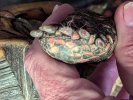
Redfoot with bleeding nails

purpledaylily

New Member
5 Year Member
Joined
Sep 20, 2015
Messages
5
My Redfoot tortoise free roams our house. I noticed she was leaving a trail of blood smears on the laminate. I inspected her feet and 3 of the outside nails are all down to the quick. I have never needed to trim her nails but I've never seem them this thin. I have locked her up in her greenhouse which is soil, larger rocks for crawling and plastic tile. I'm unsure if I should wrap her foot, or just keep clean. She walks 6- 10 hours a day around the house. Would that be the reason for the nails? The laminate is wearing them down? Thank you :)
 

Attachments

  • 2024-10-02 20.03.24.jpg
    2024-10-02 20.03.24.jpg
    839.4 KB · Views: 1

Tom

The Dog Trainer
10 Year Member!
Platinum Tortoise Club
Joined
Jan 9, 2010
Messages
68,426
Location (City and/or State)
Southern California
One more reason that they should never be free roaming a house. This is really dangerous and usually results in death or sickness.

Where are you? There is no location in your info. Does the tortoise have access to concrete anywhere in its environment?
 

purpledaylily

New Member
5 Year Member
Joined
Sep 20, 2015
Messages
5
One more reason that they should never be free roaming a house. This is really dangerous and usually results in death or sickness.

Where are you? There is no location in your info. Does the tortoise have access to concrete anywhere in its environment?
I'm in Alberta and had to bring her inside to her greenhouse. No concrete, only a couple of rocks for climbing. Lots of peat and other substrates
 

Littleredfootbigredheart

Well-Known Member
Joined
Dec 28, 2023
Messages
7,679
Location (City and/or State)
UK
I'm in Alberta and had to bring her inside to her greenhouse. No concrete, only a couple of rocks for climbing. Lots of peat and other substrates
Hello and welcome! Please never let her free roam your home, there’s a multitude of reasons it’s not a good idea. Peat moss is actually too acidic in ph and can burn their plastron! Definitely remove it, top soils aren’t good either, unless you’ve composted yourself, there’s no way of knowing what plants are in it, could be toxic. Reptisoils are often mixed with sand which is also not good for them.

Could you try answering these questions about your set up?

What are your all over day&night temperatures like?
What kind of heating&lighting are you using specifically? Packaging photos are good if you have any!
Do you use indoor uv? If so what kind?
How’s humidity reading? What else do you use for substrate?

A photo of the full enclosure would be good if you’re willing!

In the meantime please do give this thread a read, I think you’ll find it very helpful! It covers correct equipment(heating&lighting and the right uv) correct levels, substrates, appropriately maintaining humidity(which can only be in a closed chamber), sizing and more! There’s lots of visual examples for everything and a good diet list to check out!

This one is also really good to familiarise with, it helps you avoid the wrong bulbs, substrates, housing etc, it explains the above points more and is always encourage you to double check new purchases on here first if you need to!

Please give them both a read and let me know what you think! More questions welcome! Always happy to break stuff down🐢💚
 

ZEROPILOT

REDFOOT WRANGLER
Moderator
10 Year Member!
Tortoise Club
Platinum Tortoise Club
Joined
Jul 16, 2014
Messages
29,970
Location (City and/or State)
South Eastern Florida (U.S.A.)/Rock Hill S.C.
All of the previous information is great.
You can use SYPTIC POWDER for bloody nails. Same as for a dog or a bird.
I can only guess what wore through. Cut through or twisted off the nails.
Clearly something in the house that he/she was able to get to did it. But what is a guess at best.
 

Tom

The Dog Trainer
10 Year Member!
Platinum Tortoise Club
Joined
Jan 9, 2010
Messages
68,426
Location (City and/or State)
Southern California
I'm in Alberta and had to bring her inside to her greenhouse. No concrete, only a couple of rocks for climbing. Lots of peat and other substrates
It takes a LOT of serious abrasion to do that. We usually only see this when a tortoise is housed on concrete and walks on it all day. You need to figure out what is doing this and remove it. It doesn't seem like a few climbing rocks would do this, but it certainly isn't from peat or other soft substrates.

Peat is very acidic and can burn their plastron. Have you checked the plastron lately? I've never seen or head of this, but is it possible that the acidity has somehow softened the nails? Just guessing here.
 

purpledaylily

New Member
5 Year Member
Joined
Sep 20, 2015
Messages
5
Hello and welcome! Please never let her free roam your home, there’s a multitude of reasons it’s not a good idea. Peat moss is actually too acidic in ph and can burn their plastron! Definitely remove it, top soils aren’t good either, unless you’ve composted yourself, there’s no way of knowing what plants are in it, could be toxic. Reptisoils are often mixed with sand which is also not good for them.

Could you try answering these questions about your set up?

What are your all over day&night temperatures like?
What kind of heating&lighting are you using specifically? Packaging photos are good if you have any!
Do you use indoor uv? If so what kind?
How’s humidity reading? What else do you use for substrate?

A photo of the full enclosure would be good if you’re willing!

In the meantime please do give this thread a read, I think you’ll find it very helpful! It covers correct equipment(heating&lighting and the right uv) correct levels, substrates, appropriately maintaining humidity(which can only be in a closed chamber), sizing and more! There’s lots of visual examples for everything and a good diet list to check out!

This one is also really good to familiarise with, it helps you avoid the wrong bulbs, substrates, housing etc, it explains the above points more and is always encourage you to double check new purchases on here first if you need to!

Please give them both a read and let me know what you think! More questions welcome! Always happy to break stuff down🐢💚
Her enclosure is 1.8m x 1.2m. So 24 square feet. I have composite tiles with dirt and grass between the cracks and then I have coco core, plants were planted but they got eaten. I have a few climbing things for her. She has a CHE heat, UVB on for 12 hours. Ambient temp is 23°, basking is 30°. I'm keeping her locked up right now. She's not happy about it though 😆
 

Attachments

  • PXL_20241005_013055518.jpg
    PXL_20241005_013055518.jpg
    2.5 MB · Views: 1
  • PXL_20241005_013101381.jpg
    PXL_20241005_013101381.jpg
    2.5 MB · Views: 1
  • PXL_20241005_013055518.jpg
    PXL_20241005_013055518.jpg
    2.5 MB · Views: 1

Littleredfootbigredheart

Well-Known Member
Joined
Dec 28, 2023
Messages
7,679
Location (City and/or State)
UK
Her enclosure is 1.8m x 1.2m. So 24 square feet. I have composite tiles with dirt and grass between the cracks and then I have coco core, plants were planted but they got eaten. I have a few climbing things for her. She has a CHE heat, UVB on for 12 hours. Ambient temp is 23°, basking is 30°. I'm keeping her locked up right now. She's not happy about it though 😆
Thank you for the photos! I believe the amount of tile in there could actually be what’s wearing her nails a little too much, might be worth considering dumping a whole load of orchid fir bark in there for her to walk on instead.

If you could have a look through that housing link to make some needed amendments with your heating and lighting that would be great! An ambient temperature of 23c is actually too cold for a red foot, you want temperatures in the 80-86f range, they don’t technically need a basking light so I think it’s worth installing another ceramic or two, if that doesn’t keep your ground temps up enough though perhaps an oil heater in there will help too!

Also if you have the correct t5 tube uvb bulb, it only needs to be on 4hours daily.
With the uv timing, every other source of information will tell you 12hours of uv. This is essentially an old fashioned rule that has stuck with a lot of keepers, it stems from the presumption that once the basking light or ambient lighting is on, ie the ‘sun’, that uv must coexist the same amount of hours. Fact is, uv rays only peak for a few hours a day, anyone with a uv meter will confirm this. No tortoise is blasted with 12 hours of uv in the wild, especially red foots who primarily dwell the forest floor, therefore it’s not necessary in captivity.
The uv bulbs are much more expensive to replace once their uv strength diminishes, so it’s definitely best having it on a 4 hour timer that provides them with all the uv they need, saving your bulb life.
Then some cheaper led lighting for your ambient 12 hour light cycle is fine, your ceramics will run 24/7 on a thermostat, hopefully this will all make more sense after you read that thread above🙂
 

New Posts

Top